
The removal of a board member is sometimes the only remaining solution for addressing governance problems. That said, it is a significant action that often requires careful thought and a structured process. Board members and homeowners should follow state laws and the governing documents to avoid legal challenges.
Is the Removal of a Board Member Possible?
In an HOA or condo community, board members are responsible for operations, maintenance, and governance. When a director is no longer effective in their role, the possibility of removing them crosses most minds.
Simply put, HOAs and condo associations can generally remove board members, but the procedure varies by state law and governing documents. Most states have HOA laws or nonprofit corporation laws that apply, since most associations are incorporated as nonprofits.
In Virginia, for instance, Section 13.1-860 of the Nonstock Corporation Act addresses the removal of directors. Under this law, members may remove a director with or without cause unless the articles of incorporation provide otherwise. Elected directors may only be removed by the people who elected them.
In DC, similar statutes exist. Section 29-406.08 states that members can generally remove directors with or without cause unless the articles of incorporation say otherwise. As in Virginia, only the people who elected the directors have the power to remove them.
Reasons to Remove a Board Member
More often than not, a director may be removed with or without cause. Yet, some association bylaws or articles do require specific reasons. Here are the most common grounds for removal of HOA officers or directors.
- Failure to perform board duties
- Conflict of interest
- Misuse of HOA funds
- Breach of fiduciary duties
- Violating the governing documents
- Abuse of board authority
- Dishonesty or fraud
- Loss of eligibility
- Conduct that harms the association
How to Remove an HOA Board Member
Specific steps for removing a board member will depend on the association’s governing documents. That said, the requirements and procedures generally include the following.
1. Gather a Petition to Remove HOA Board Member
Homeowners generally have the power to initiate the removal process, but exact authority can depend on the bylaws. In Virginia and D.C., the law explicitly states that an elected director may be removed only by the same voting group. For most communities, this refers to the members or homeowners, including board members.
That said, board members should never remove an elected director simply because of a difference in opinion. While the board should present a unified front, disagreements are bound to arise, as directors may have conflicting perspectives. Cooperation and an open mind are valued qualities.
If homeowners initiate the removal process, the governing documents typically specify the minimum number or percentage of signatures required to call a special meeting. These signatures must be included in the petition.
2. Provide Proper Notice
After receiving the petition and assuming it meets all requirements, the association should provide proper notice of the special meeting. Notice requirements can vary from one HOA to another. It is best to check the governing documents to ensure compliance.
In general, the special meeting notice should include:
- Date of the meeting
- Time of the meeting
- Location or electronic access information
- Purpose of the meeting
- Name of the director whose removal will be considered
- Voting procedures
- Any applicable proxy or ballot information
The notice should clearly identify that the purpose of the meeting is to remove a director. This will avoid surprising homeowners with the removal vote.
Additionally, it is common practice to provide notice to the director being considered for removal. They should know that the special meeting is about their position on the board.
3. Hold the Special Meeting and Vote
At the special meeting, the association must follow its meeting procedures. This includes taking attendance and establishing a quorum. A quorum is the minimum number of participants required to conduct official business. It is generally mandatory.
As for the removal itself, the membership typically hears arguments both for and against it. The director in question may also have a chance to speak. After that, the association can conduct the required vote.
Generally, a director doesn’t need to attend the meeting for the membership to vote on their removal. The only exception is if the governing documents say otherwise. Of course, requiring attendance may delay the removal vote if the director continues to fail to show up.
The voting threshold for removing a director depends on the governing documents. After counting the votes, the board should announce the results. The secretary must then record the vote in the meeting minutes.
4. Fill the Open Seat
After removing the director, the association must then fill the vacancy. Some governing documents allow the remaining directors to appoint a replacement. Meanwhile, others require an election, with the membership voting to select a replacement.
In Virginia, the Condominium Act provides specific guidance. According to Section 55.1-1940, unless the governing documents say otherwise, the remaining directors shall fill the vacancy by a majority vote. The replacement will then serve until the next annual meeting, where the owner will elect a successor.
HOA Officer Removal vs. HOA Board Removal
Removing an officer is not necessarily the same as removing a director. A board member can hold two separate positions. For example, someone might be both a director and the board’s treasurer, the latter of which is an officer role.
In general, board members have the authority to remove an officer. This essentially strips them of their role as president, VP, secretary, or treasurer. That said, they are still part of the board, serving as a director.
The distinction matters because of the removal requirements and procedures. Removing a director often requires a membership vote, whereas removing an officer usually requires a board vote.
Sample Petition to Remove HOA Board Member
Download Your Sample Petition to Remove HOA Board Member Here
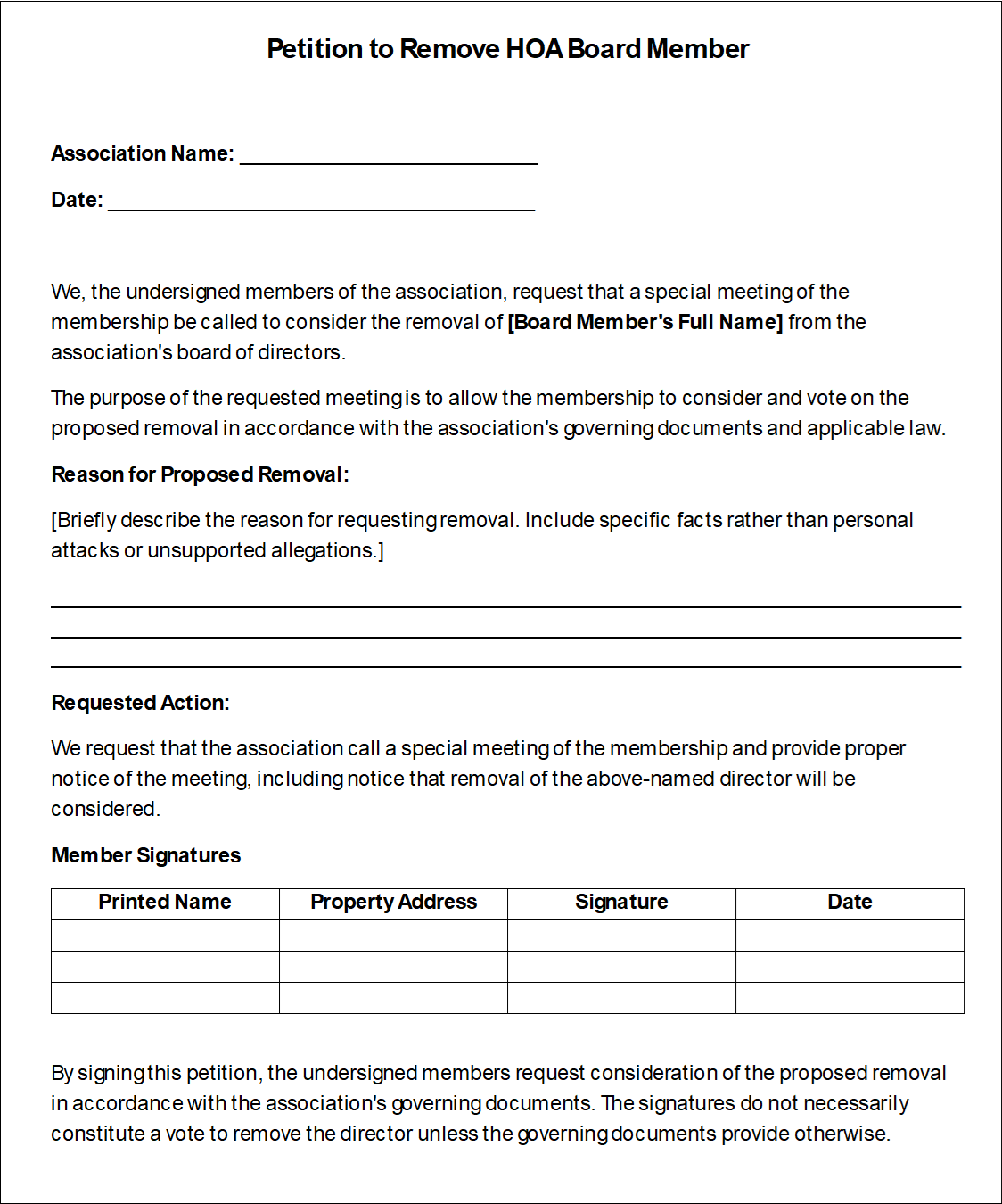
Download Your Sample Petition to Remove HOA Board Member Here
Alternatives to Remove HOA Board Member
Removing an HOA board member is often a drastic measure. There are other ways to address a director’s conduct or disagreements before pursuing removal, such as:
- Discussing the problem with the director,
- Reassigning board responsibilities,
- Removing the director from an officer position,
- Adopting clearer board policies,
- Going through the internal dispute resolution process,
- Seeking alternative dispute resolution,
- Voting differently at the next election, and
- Hiring professional help from a lawyer or HOA management company.
Avoid Treating the Matter Lightly
The removal of a board member is a serious action, so it should not be taken lightly. Boards and owners must understand what the process entails, what requirements must be met, and what limitations are in place. From there, a successful removal with minimal backlash can happen.
Majerle Management, Inc. provides management services to HOAs and condo associations in Maryland. Call us today at (301) 220-1850 or contact us online to start your journey!
RELATED ARTICLES:
- Can An HOA Be Dissolved? Should Your Community Do It?
- Neighbor Violating HOA Rules: Why A Clear Process Matters
- What Happens When The State Takes Over An HOA?